Table des Matières
The oil and gas industry generates more data per hour of operation than almost any other sector. A single modern drilling rig produces hundreds of sensor readings per second. A mid-size refinery's DCS logs tens of millions of data points daily. For decades, the vast majority of this data was either discarded or stored in historians that nobody interrogated.
AI changes that equation entirely. The following seven use cases represent the most commercially proven applications of AI in North African oil and gas operations — deployments that have moved beyond pilot phase and are delivering measurable returns at scale.
Use Case 1: Drilling Optimization
What it does: AI models analyze real-time drilling parameters — weight on bit, rotary speed (RPM), torque, flow rate, mud weight, rate of penetration — alongside historical well data and geological prognosis to recommend optimal drilling parameters in near-real time. More sophisticated systems also detect drilling dysfunctions (bit bounce, stick-slip, whirl) before they cause equipment damage or non-productive time.
Why it matters in North Africa: Algeria's Illizi, Berkine, and Ahnet basins present complex geological challenges — interbedded carbonates, pressure transition zones, high-temperature formations — that make drilling efficiency particularly sensitive to parameter optimization. Sonatrach's drilling program, which targets dozens of new wells annually, makes even marginal efficiency improvements economically significant at scale.
Typical ROI: 15–20% reduction in drilling cost per metre; 10–15% reduction in non-productive time (NPT). For a directional well costing $8–12M, AI-assisted drilling optimization can save $1.2–2.4M per well.
Implementation complexity: Medium. Requires integration with surface measurement-while-drilling (MWD) and logging-while-drilling (LWD) data feeds. Most modern drilling rigs have the sensor infrastructure; the challenge is data quality and real-time connectivity to the AI system.
Use Case 2: Reservoir Simulation and Characterization
What it does: Traditional reservoir simulation requires months of specialist geoscience work to build and history-match a numerical model. AI accelerates this process by automatically integrating seismic interpretation, well log data, production history, and fluid sampling results to generate probabilistic reservoir models. Machine learning techniques — particularly convolutional neural networks applied to seismic data — can identify reservoir facies and structural features that take human interpreters significantly longer to map.
Why it matters in North Africa: Many of Algeria's producing fields have been on production for 30–50 years. Reservoir characterization quality directly determines how effectively infill drilling programs are designed and how much incremental recovery is achievable from existing fields before they enter decline. Better reservoir models mean better wells drilled in better locations.
Typical ROI: 40–60% reduction in reservoir modeling turnaround time; improved history-match quality leading to more reliable production forecasts. Indirect ROI through improved well placement is field-specific but often exceeds the direct time savings.
Implementation complexity: High. Requires access to integrated subsurface data repositories (seismic, well logs, production), specialist AI configuration, and geoscience expertise to validate model outputs. Not a plug-and-play deployment, but the payoff justifies the investment for mid-to-large fields.
Use Case 3: Pipeline Integrity Monitoring and Leak Detection
What it does: AI analyzes pressure, flow rate, temperature, and acoustic sensor data along pipeline networks to detect anomalies consistent with leaks, third-party interference, or structural degradation. Advanced systems use transient analysis combined with ML to distinguish genuine leaks from measurement noise or operational transients, and can pinpoint leak location to within a few hundred metres.
Why it matters in North Africa: Algeria's gas export pipeline network — feeding into the Trans-Mediterranean (Transmed) and Medgaz pipelines to Europe — is both strategically critical and geographically extensive. Libya, Tunisia, and Egypt similarly have substantial pipeline infrastructure crossing difficult terrain. A large leak event is not only an environmental and safety incident; it is a significant revenue loss and, for export pipelines, a geopolitical event. The current state of manual monitoring means that many leaks are detected hours after onset.
Typical ROI: Reduction in leak detection time from 4+ hours (manual monitoring) to under 30 minutes; prevention of one major pipeline incident per year at a 1,000 km pipeline network delivers ROI many times the system cost. Environmental liability avoidance and regulatory compliance value is additional.
Implementation complexity: Medium. Modern pipelines typically have sufficient instrumentation. Key requirements are reliable SCADA data feeds and a well-calibrated hydraulic model of the pipeline as a reference baseline.
Use Case 4: Refinery Process Optimization
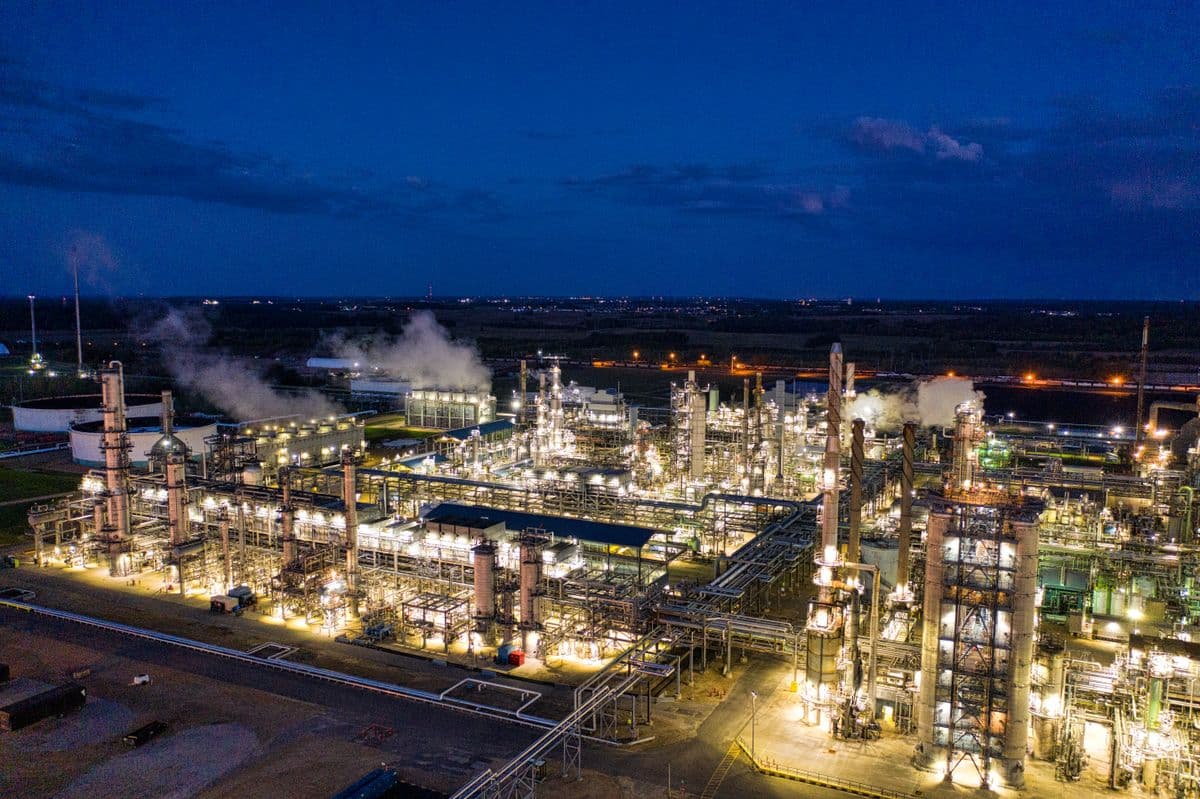
What it does: AI models — typically using Model Predictive Control (MPC) enhanced with machine learning — continuously optimize refinery unit operations: crude distillation units, fluid catalytic crackers (FCC), hydrotreaters, and reformers. The AI recommends set-point adjustments to maximize yield of high-value products (diesel, jet fuel, naphtha) while respecting equipment constraints and product quality specifications.
Why it matters in North Africa: Algeria's refinery network — Skikda, Arzew, Hassi Messaoud, Adrar — processes a significant fraction of the country's crude production. At current throughput levels, a 2–3% improvement in product yield efficiency translates to tens of millions of dollars annually per major refinery. Most North African refineries also face the challenge of processing variable crude blends, which creates ongoing optimization pressure that AI handles better than fixed control strategies.
Typical ROI: 2–3% improvement in energy efficiency; 1–2% yield increase on high-value products; reduction in off-specification production. Combined, this typically represents $5–15M per year for a medium-sized refinery.
Implementation complexity: Medium–High. Requires integration with the refinery's DCS and laboratory information management system (LIMS). The AI must be trained on the specific refinery's process configuration — generic models do not transfer well between different refinery designs.
| Refinery Unit | Primary AI Optimization Lever | Typical Benefit | |---|---|---| | Crude Distillation Unit | Cutpoint optimization, energy balance | 1.5–2% energy saving | | Fluid Catalytic Cracker | Catalyst activity prediction, reactor temp | 1–2% gasoline yield increase | | Hydrotreater | Feed rate optimization, H₂ consumption | 5–10% H₂ saving | | Reformer | Severity optimization, catalyst cycle management | Extended catalyst life |
Use Case 5: HSE Compliance Automation
What it does: AI systems monitor safety-critical parameters — gas detector readings, pressure relief valve activations, personal protective equipment (PPE) compliance via computer vision, permit-to-work status, and incident report patterns — to provide real-time HSE situational awareness and predictive safety alerts. Natural language processing (NLP) systems analyze historical incident reports, near-miss records, and maintenance logs to identify recurring precursor patterns before they escalate to incidents.
Why it matters in North Africa: HSE performance in North African oil and gas is subject to both regulatory scrutiny and, for companies with international partnerships or export contracts, external audit requirements. AI-driven HSE monitoring creates a continuous, auditable record that is far more defensible than manual reporting. It also enables proactive intervention rather than reactive incident response.
Typical ROI: Difficult to quantify in advance — a prevented fatality or major process safety event avoids both human tragedy and costs that can reach hundreds of millions of dollars in clean-up, liability, and reputational damage. Observable metrics include: 20–30% reduction in near-miss frequency; improved permit-to-work compliance rates; faster incident investigation resolution.
Implementation complexity: Medium. Computer vision for PPE monitoring requires camera installation in relevant work areas. Data integration from gas detection systems and DCS is typically straightforward. NLP for Arabic and French incident reports requires AI systems that genuinely support these languages.
Use Case 6: Predictive Maintenance and Maintenance Scheduling Optimization
What it does: Rather than maintaining equipment on fixed calendar schedules (which leads to both over-maintenance of healthy equipment and under-maintenance of equipment that is degrading faster than expected), AI analyzes vibration data, temperature trends, oil analysis results, and operational history to predict when specific assets — compressors, pumps, heat exchangers, turbines — will require attention. Maintenance is scheduled based on actual equipment condition.
Why it matters in North Africa: Unplanned downtime at a gas processing plant or compressor station is extraordinarily expensive — both in lost production and in emergency mobilization of specialist maintenance teams, which often must travel significant distances to remote Saharan locations. Predictive maintenance reduces both the frequency of emergency callouts and the total maintenance labour expended on equipment that did not need attention.
Typical ROI: 15–25% reduction in maintenance costs; 30–50% reduction in unplanned downtime; 10–15% extension of equipment life. For a major gas processing facility, unplanned compressor downtime can cost $500K–$2M per day in lost throughput — one prevented outage per year covers the cost of the system.
Implementation complexity: Low–Medium. Many assets already have vibration and temperature monitoring instrumentation. The primary integration requirement is connecting this data to the AI system and building an asset hierarchy that allows condition to be tracked at the component level.
Use Case 7: Document Intelligence for Arabic and French Technical Manuals
What it does: AI-powered document intelligence platforms ingest, structure, and make searchable the vast libraries of technical documentation that oil and gas operations accumulate over decades: equipment manuals, standard operating procedures (SOPs), inspection reports, modification records, and regulatory correspondence. Engineers can query these systems in natural language — in Arabic, French, or English — and receive precise, sourced answers rather than spending hours searching document repositories.
Why it matters in North Africa: This use case is more critical in the North African context than anywhere else in the world. Algerian oil and gas operations have decades of technical documentation split between Arabic and French, often in scanned paper format, stored in filing systems of varying quality. When an experienced engineer retires, their knowledge of where to find relevant documentation often leaves with them. AI document intelligence preserves and democratizes this knowledge.
Typical ROI: 30–50% reduction in time engineers spend searching for technical information; improved procedure compliance when relevant SOPs are instantly accessible; capture of institutional knowledge that would otherwise be lost.
Implementation complexity: Low–Medium. Does not require integration with operational systems; can be implemented as a standalone knowledge management platform. The critical requirement is AI that genuinely understands Arabic and French technical language, not systems that require translation to English before processing.
Where to Start
For North African oil and gas operators evaluating where to begin their AI journey, the practical recommendation is to start with use cases that:
- Have clear, measurable ROI — pipeline monitoring, predictive maintenance, and document intelligence all have well-established business cases
- Do not require deep integration with operational control systems — lower technical risk for initial deployments
- Can run on-premise — preserving data sovereignty and avoiding cloud dependency for sensitive operational data
- Support Arabic and French — ensuring the AI actually works for the people who will use it
The worst outcomes in industrial AI deployments come from trying to deploy everything at once. The best outcomes come from starting with a focused use case, demonstrating value clearly, building internal confidence and capability, and then expanding systematically.
The technology is proven. The business case is established. For North African oil and gas operators, the question is no longer whether to deploy AI — it is where to start.